Do Rewards Kill Kids' Motivation? How to Balance Praise and Rewards
Tangible rewards promised in advance, like “If you do it, I'll give you X,” can lower the desire to do things for their own sake (intrinsic motivation), and this effect was especially strong in children (Deci et al., meta-analysis of 128 experiments). Unexpected rewards after the fact had no effect. So use rewards briefly, phase them out once a habit forms, and pair them with praise and time together.
What does research say about rewards?
The best-known research on rewards and motivation is a meta-analysis of 128 experiments by psychologist Edward Deci's team (1999, Psychological Bulletin). Here are the key findings.
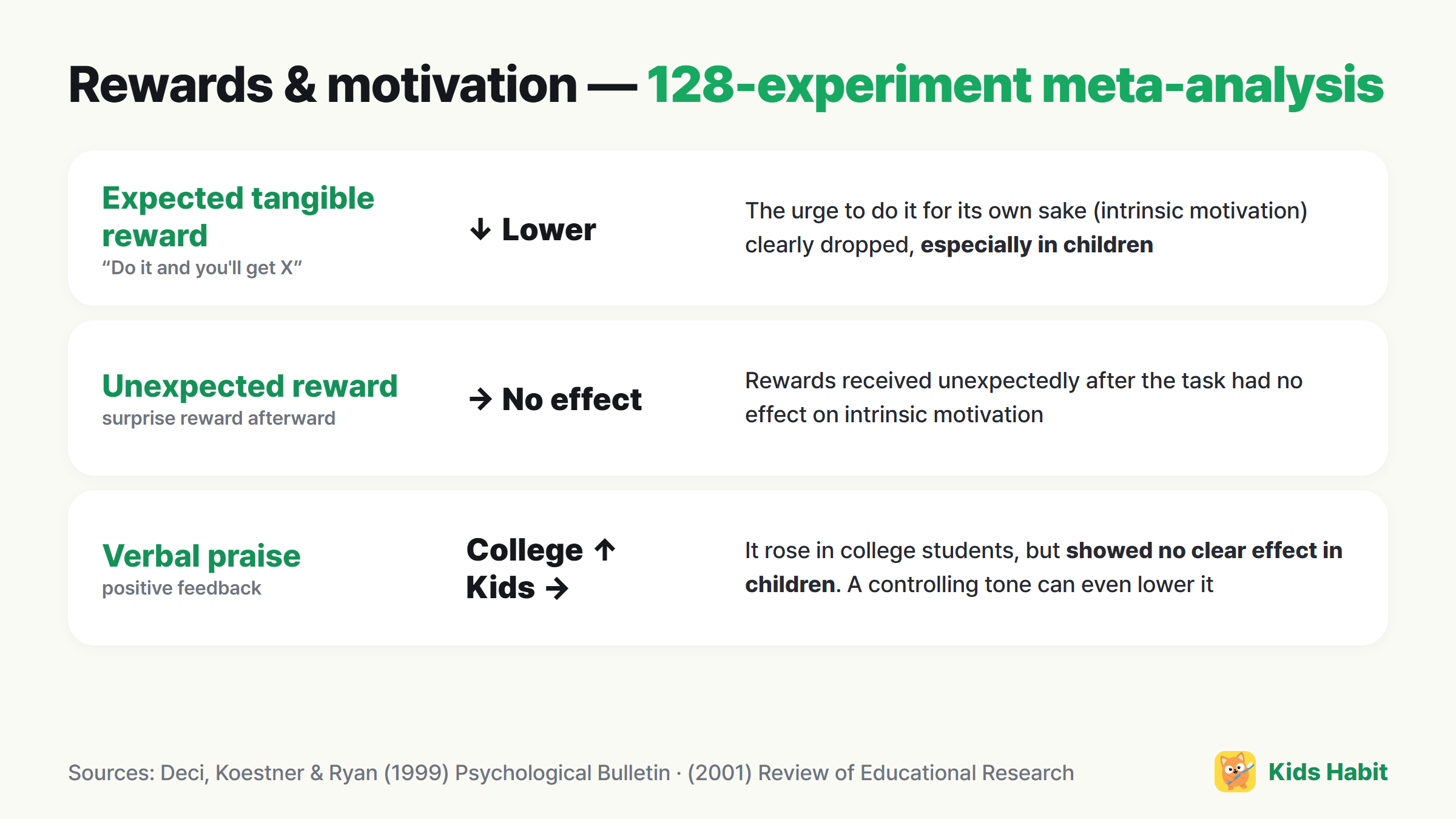
- Tangible rewards promised in advance: Clearly lowered intrinsic motivation, and this effect was especially strong in children.
- Unexpected rewards: Rewards received unexpectedly after finishing a task had no effect on intrinsic motivation.
- Verbal praise (positive feedback): Raised intrinsic motivation in college students, but showed no clear effect in children. The authors also explain that praise given in a controlling tone can actually lower it.
Based on these results, the researchers concluded that great caution is needed when using reward-centered approaches to motivation. Note, however, that this research measured intrinsic motivation for “activities people already find interesting.” It's hard to say for certain that it applies in the same way to things kids don't enjoy from the start, like brushing their teeth.
So should we avoid reward sticker charts?
Not necessarily. The US Centers for Disease Control and Prevention (CDC) and the American Academy of Pediatrics (AAP) say rewards can help increase desirable behavior, while emphasizing how to use them. Looking at the meta-analysis and the organizations' guidance together, it comes down to this.
- Use rewards briefly, “to get started”: The AAP advises ending the reward chart gradually once your child has learned the behavior and forgets about the points or loses interest.
- Social rewards over things: The CDC says social rewards such as praise, hugs and high fives, and time together are often more powerful than things and easier to give.
- Praise that doesn't control: Rather than “You did what Mom said,” point out what your child did on their own, as in “You started brushing all by yourself.” The researchers explain that praise in a controlling tone can lower motivation.
- Occasional surprise rewards: In the research, unexpected rewards had no effect on intrinsic motivation. Instead of always promising rewards, mix in occasional surprise praise and time together.
- Never take back rewards already given: The CDC advises not taking away rewards your child has earned, even after misbehavior.
How do you use rewards and praise together?
Use points as a starting push for a habit, and offer specific praise each time you approve. Choose rewards together as a family, and you can put non-material rewards, like time together, on the list too.

Frequently asked questions
Won't sticker charts make my child care only about rewards?
They can. In the meta-analysis (Deci et al. 1999), tangible rewards promised in advance lowered children's intrinsic motivation. So use rewards briefly, phase them out once a habit forms (AAP), and pair them with social rewards like praise and time together (CDC).
Isn't praise alone enough?
In the same meta-analysis, verbal praise worked for college students but showed no clear effect in children. The recommended way to praise is to point out specific effort and things your child did on their own, rather than results (CDC · AAP).
When should we stop rewards?
The American Academy of Pediatrics (AAP) advises ending them gradually once your child has learned the behavior and forgets about the points or loses interest.
References
- Deci, Koestner & Ryan (1999) — A meta-analytic review of experiments examining the effects of extrinsic rewards on intrinsic motivation, Psychological Bulletin 125(6)
- Deci, Koestner & Ryan (2001) — Extrinsic Rewards and Intrinsic Motivation in Education: Reconsidered Once Again, Review of Educational Research
- US Centers for Disease Control and Prevention (CDC) — Using Rewards
- American Academy of Pediatrics (AAP) HealthyChildren — Positive Reinforcement Through Rewards
This article provides general parenting information based on materials from official organizations and does not replace diagnosis or treatment. If you're concerned about your child's health or development, consult a specialist such as a pediatrician or pediatric dentist.


